|
|
Latest Articles

New Movies








Foreign

|

Torrent Description
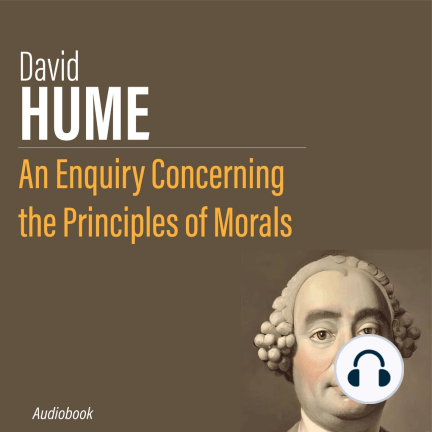 Category: Classic, Misc. Non-fiction, Spiritual & Religious Written by David Hume Read by Liam Johnson Format: MP3 Bitrate: 96 Kbps An Enquiry Concerning the Principles of Morals Written by David Hume Narrated by Liam Johnson Language: English Publisher: Stream Readers Audio Release date: Mar 5, 2023 ISBN: 9781987127492 “An Enquiry Concerning the Principles of Morals” is a philosophical treatise written by the Scottish philosopher David Hume. The work was first published in 1751 and is one of Hume’s most important works, along with “A Treatise of Human Nature” and “Dialogues Concerning Natural Religion”. In “An Enquiry Concerning the Principles of Morals”, Hume explores the nature and foundation of morality. He argues that moral judgments are not based on reason, but on sentiment, or a natural feeling of approval or disapproval that we have towards certain actions or behaviors. He maintains that moral distinctions are not objective features of the world, but rather the products of human psychology. Hume also argues that morality is not derived from religion or any other external source, but rather is grounded in human nature and the natural sentiments that we have towards others. He emphasizes the importance of sympathy, or the ability to feel and understand the emotions of others, in the development of moral sentiments. Overall, “An Enquiry Concerning the Principles of Morals” is a significant contribution to the field of moral philosophy and continues to be widely studied and debated by scholars today. David Hume was an eighteenth-century Scottish philosopher, historian, and essayist, and the author of A Treatise of Human Nature, considered by many to be one of the most important philosophical works ever published. Hume attended the University of Edinburgh at an early age and considered a career in law before deciding that the pursuit of knowledge was his true calling. Hume’s writings on rationalism and empiricism, free will, determinism, and the existence of God would be enormously influential on contemporaries such as Adam Smith, as well as the philosophers like Schopenhauer, John Stuart Mill, and Karl Popper, who succeeded him. Hume died in 1776.
Related Torrents
|
|||||||||||||||||||||||||||||||||||||||||||||||||||||||||||||||||||||||||



Home - Browse Torrents
ExtraTorrent.st is in compliance with copyrights
2025 ExtraTorrent.st