|
|
Latest Articles

New Movies








Foreign

|
![Download Lie groups, physics, and geometry - R. Gilmore - Cambridge [PDF] [ENG] torrent](/images/download_normal.gif)
Torrent Description
Titre: Lie groups, physics, and geometry - an introduction for physicists, engineers and chemists Auteur: R. Gilmore Editeur: Cambridge Date: 2008 Langue: Anglais Discipline: Physique Domaine: Outils Mathématiques, Physique Mathématique, Théorie des Groupes, Algèbres de Lie, Algèbre Linéaire/Multi Niveau: M1 M2 Format: pdf Description: Describing many of the most important aspects of Lie group theory, this book presents the subject in a 'hands on' way. Rather than concentrating on theorems and proofs, the book shows the applications of the material to physical sciences and applied mathematics. Many examples of Lie groups and Lie algebras are given throughout the text. The relation between Lie group theory and algorithms for solving ordinary differential equations is presented and shown to be analogous to the relation between Galois groups and algorithms for solving polynomial equations. Other chapters are devoted to differential geometry, relativity, electrodynamics, and the hydrogen atom. Problems are given at the end of each chapter so readers can monitor their understanding of the materials. This is a fascinating introduction to Lie groups for graduate and undergraduate students in physics, mathematics and electrical engineering, as well as researchers in these fields. - Focuses on the applications of Lie group theory to physical sciences and applied mathematics, rather than on theorems and proofs - Each chapter ends with problems, so readers can monitor their understanding of the subject - Many examples of Lie groups and Lie algebras are given throughout the text En décrivant plusieurs des aspects les plus importants de la théorie des groupes de Lie, ce livre présente le sujet de manière «pratique». Plutôt que de se concentrer sur les théorèmes et les preuves, le livre montre les applications du matériel aux sciences physiques et aux mathématiques appliquées. De nombreux exemples de groupes de Lie et d'algèbres de Lie sont donnés dans tout le texte. La relation entre la théorie du groupe de Lie et les algorithmes pour résoudre les équations différentielles ordinaires est présentée et se révèle analogue à la relation entre les groupes Galois et les algorithmes pour résoudre les équations polynomiales. D'autres chapitres sont consacrés à la géométrie différentielle, à la relativité, à l'électrodynamique et à l'atome d'hydrogène. Des problèmes sont donnés à la fin de chaque chapitre afin que les lecteurs puissent surveiller leur compréhension des matériaux. C'est une introduction fascinante aux groupes de Lie pour les étudiants diplômés et les étudiants de premier cycle en physique, mathématiques et électrotechnique, ainsi que des chercheurs dans ces domaines.
Related Torrents
|
|||||||||||||||||||||||||||||||||||||||||||||||||||||||||||||||||||||||||


 fr
fr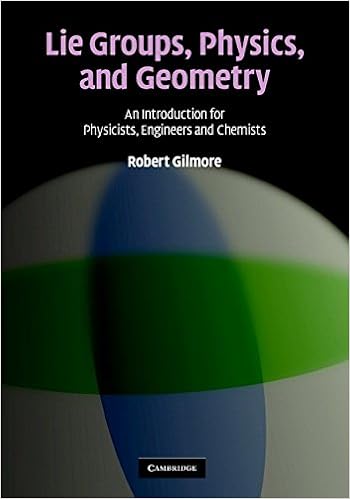

Home - Browse Torrents
ExtraTorrent.st is in compliance with copyrights
2025 ExtraTorrent.st